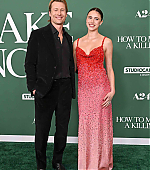
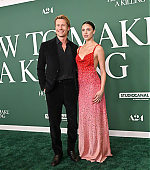
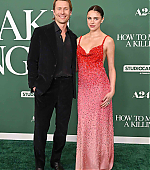
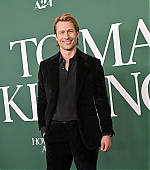
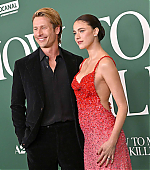
Glen Powell Plays the Long Game
Glen covers his first issue of Texas Monthly!

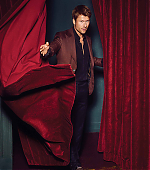

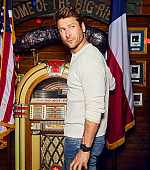
Photoshoots > Outtakes > Session 052
TEXAS MONTHLY – The star of Chad Powers and the upcoming The Running Man has been acting since he was in middle school in Austin. His family makes sure he never forgets where he came from.
The Powells emerge on the patio of Josephine House, a popular restaurant in their hometown of Austin, one by one. First Glen Jr. appears, wearing cowboy boots, blue jeans, a brown striped sweater, a Longhorns cap, and his signature face-stretching smile. Then comes his mother, Cyndy, and finally his father, Glen Sr., who had been tasked with parking the car, as dads often are. They also come bearing Christmas-card grins.The 37-year-old actor’s parents have been an ambient presence in his rise to stardom. They frequently join him on red carpets and have had cameos in all his films since the first, 2003’s Spy Kids 3-D: Game Over (they played two spies). The previous weekend, the trio had traveled to attend the University of Texas at Austin’s first football game of the season, against Ohio State University, in Columbus. Before that Cyndy and Glen Sr. had visited their son in East Providence, Rhode Island, where he was filming. You can take the boy out of Texas, but his mom and dad are coming with him.
It is early September, and the comedown from the afternoon heat has been slow. It’s still 90 degrees in the evening, but when the server tells the group that no tables are available inside, the Powells assure her they’re fine—really, fine!—and bless her with their singular smiles. A small fan whirring in the upper corner of the alcove where we sit provides only a warm breath, like that of a stranger standing too close in an elevator, but Glen Jr. does not remove his sweater, nor does he appear to wilt. Instead he orders a cup of green tea, as if to demonstrate how unbothered he is by the heat. His father and I ask for iced teas, and his mother says she is fine with water (as moms often are).
Glen Jr. is on tandem buzz-building missions for his next film, The Running Man, a remake of the Arnold Schwarzenegger movie that premieres November 14, and Chad Powers, the new series he both stars in and cowrote. Adapted from an ESPN+ skit in which football great Eli Manning goes undercover to join an open call for quarterbacks at Penn State, the comedy hit Hulu in late September.
His parents, of course, appear in both productions. In Chad Powers, Glen Sr. portrays an assistant coach. This role isn’t a stretch for him: He was an executive coach by trade (he has reportedly done assessments of his son’s strengths and weaknesses in relationships upon request), and he’s also coached two dozen children’s basketball teams over the years. His nickname is Coach.
Cyndy, meanwhile, plays “moaning woman,” a patient waiting next to Glen Jr.’s character in an emergency room. One of the Powells’ two daughters, Leslie, a singer, coached her mom for ten minutes a day on how to “moan well,” as Cyndy, a homemaker, had no prior professional moaning experience. Perhaps the coaching worked too well. “I come out in the morning after her practicing, and all my guy neighbors are going, ‘Attaboy!’ ” her husband says. Cyndy and Glen Jr. both laugh.
It is unusual for an actor’s family to be so involved in his work. Being on a film set, Glen Jr. explains, is “like doing theater on an active construction site,” and visitors have to be trusted with confidential information. It is also unusual for family members to be present during press tours to the extent that the Powells are. “It’s so funny how actors roll their eyes at this part of the process,” Glen Jr. says of the interviews and television appearances that precede a big release, “but if you have friends and family, everybody wants to be a part of it.”
The Powells are accustomed to Glen Jr. receiving not just a plus-one but a hundred plus-ones, for them and their extended family. They often pose for photos with him and sometimes make themselves known through gentle parental bullying. At an Austin screening for his film Hit Man in May 2024, Cyndy and Glen Sr. carried signs that read “Stop trying to make Glen Powell happen” and “It’s never gonna happen,” respectively. Two months later, at another appearance to promote the summer blockbuster Twisters, their signs read “I changed Glen Powell’s diapers” and “Glen Powell is our force of nature.” Before Christmas in 2023, Glen Jr., Leslie, and their elder sister, Lauren, ran through the streets of New York City dressed in bright green elf costumes, reenacting scenes from the Will Ferrell film Elf. The Powells are the family that, when everyone at a graduation is told not to clap when their child’s name is called, stands en masse and claps loudly anyway.
Glen Jr. and his parents describe the milestones of his career as a collective, speaking in turns as they tell stories. When he is trying to remember a detail, he pauses mid-sentence and squints at his father for several moments, as if trying to absorb the shared memory. As the family tells it, fame has happened not just to Glen Jr. but to “us.” The Powells are like a Texas-based corporation, Powell & Powell & Powell & So On.
Glen Jr.’s demeanor as he navigates Hollywood and its incumbent press tours often resembles a politician’s as much as an actor’s. He’s unfailingly articulate and polite, and his charm is constant. He and costar Sydney Sweeney have discussed how they played up their chemistry ahead of their 2023 rom-com, Anyone But You. “Sometimes you just have to lean into it a bit—and it worked wonderfully,” Glen Jr. told The New York Times. He and Sweeney bantered in interviews and posted flirty photos on Instagram. The feverish speculation over a romance between them was renewed last spring when Sweeney attended Leslie’s wedding in Dallas. (“They’re definitely not together,” Cyndy told the Daily Mail. “We love Sydney. We’ve considered her just a really, really good friend.”)
Glen Jr. is also shrewd about what he reveals of his personal life. He indulges the media and the internet with photos of Brisket, the fanciest-looking rescue dog in America, and with commentary that at first glance seems vulnerable but is, when you pause to consider it, completely neutral.
His swagger has helped him become an ambassador for his home state and a household name, apparently immune to the corrosive effects of Hollywood on a personality. With his loving family, his adorable dog, his Longhorn pride, the on-brand condiment business he cofounded (Smash Kitchen), and his winning smile, he is nearly too good at being a celebrity. Why hasn’t it all curdled into a bland shtick by now?
or one thing, Glen Jr. didn’t find himself in Hollywood until his prefrontal cortex was just about fully baked. Though he acted as a kid, his parents would never have let young Glen move to California. They wanted him to have a real childhood, his mother says after we have placed our dinner orders. The child-actor-in-Hollywood trajectory so rarely works out, she adds. Instead, Glen Jr. had a pretty idyllic upbringing. Cyndy and Glen Sr., who married in 1984, raised their three children in Austin. Their son grew up surrounded by relatives; his extended family has a ranch in East Texas. Now guests from L.A. and beyond converge there annually for a giant party. (The family took my request for an invitation as a joke.)
Their son leans back in his chair with one arm draped across its back, settling in as his parents describe how Glen Powell came to be Glen Powell. He smiles and laughs indulgently when they share anecdotes of his childhood heroics, lore he has surely heard over and over: the time a kindergarten teacher predicted he would either be an actor or the president; the time one of his writing assignments was so good that his teacher summoned his parents to school and told them, “There’s no way a boy that age could write that way.” Glen Sr. says he asked for another assignment right there, which his son handily completed in thirty minutes, earning an apology from the teacher. All celebrities should bring their parents to interviews.
His first theater performance was in Austin Musical Theatre’s production of The Music Man in 2000, when Glen Jr. was eleven and attending Canyon Vista Middle School. He had just one line, which he delivered in a band uniform with a little red hat, but his parents, who went to as many performances as they could, still remember how proud they were. “That’s my boy!” they both say in unison now, laughing.
His ascent to movie stardom appeared sudden to many, but it wasn’t easy or immediate. He landed his first film role, as Long-fingered Boy, in Robert Rodriguez’s Spy Kids 3-D: Game Over, much of which was shot in Austin in 2003, when he was fourteen. (A young Selena Gomez also appears in the film, an unexpected star-maker, as Waterpark Girl.)
Rodriguez says it’s actually pretty easy to cast child actors. “There are always only a few who are just clearly gifted with a star quality and ability to nail every scene and rise head and shoulders above everyone else,” notes the Austin-based director. Rodriguez, who always welcomes young locals to audition for main roles, says that when a local actor is good it means they’re really good—naturally so—because they typically don’t get the same opportunities as children in Los Angeles do.
Glen Jr., he recalled, already had a memorable enthusiasm and charisma as a teenager. After the actor finished his scenes, Rodriguez told the parents how pleased he was with their son’s performance and asked what Glen Jr.’s goals were. “His mother told me that he was serious about acting and wanted to try to go all the way with it. I remember being very impressed by that.” (Rodriguez had planned to make the character a CGI robot if he couldn’t find the right actor. “Glen was so great, I left him as a human.”)
That Glen Jr. doesn’t register today as having been a child actor is a credit to his parents, who kept him in school and encouraged him and his sisters to pursue multiple interests, which for their son included lacrosse and football. The Powells have a family motto: “Advance on all fronts.”
While Glen Jr. took on more acting roles in his teens, few of his classmates knew about his extracurricular career. Michele Koteras, his counselor at Westwood High School, recalls that when he needed a fine-arts credit to graduate, he opted to take an introductory theater class. “His teacher had no idea that he was filming movies,” Koteras says. “He also took a debate class while he was filming The Great Debaters”—a 2007 film starring and directed by Denzel Washington—“and the teacher never knew, just thought he was teaching him how to do debate.”
After The Great Debaters came out, when Glen Jr. was a freshman at UT, Washington and his agent, Ed Limato (“a Hollywood superagent,” Cyndy adds), encouraged him to move to Los Angeles. Limato had also represented Michelle Pfeiffer, Kevin Costner, and Mel Gibson, among other stars. “He said, ‘Your son has what it takes to make it in Hollywood, and I will introduce him to the right people,’ ” Glen Sr. says. The actor promptly dropped out of school and moved to California, and he was possibly one of the last to sign with Limato before the agent died of lung disease, in 2010. “So then we’re back to all alone,” Glen Sr. says placidly.
The family is grateful to Limato. His endorsement gave Glen Jr.’s mom and dad confidence—“as parents you see it, but you don’t know if other people see it,” says Glen Sr.—and his invitation brought the actor to Hollywood. “It got us out there,” Glen Jr. says. “That was the charge that lit the fuse.”
It was another decade or so before that fuse kaboomed into recognizability. Glen Jr. started accumulating small roles in big films. In 2012’s The Dark Knight Rises he played a stock trader who gets hurled into a bank of computers while still in his chair, and he seemed to have found his niche in the “whiny jerk” space. But then, a few years later, Austin filmmaker Richard Linklater, who had directed a teenage Glen Jr. in a minor role in his 2006 film Fast Food Nation, cast him in the eighties college-stoner flick Everybody Wants Some!!
His character, a baseball player named Finnegan, was affable and iconic, similar in vibe and mustache to Matthew McConaughey’s Wooderson in Linklater’s Dazed and Confused. Like McConaughey, Glen Jr. had an unbounded confidence and an easy, indiscriminate charm, and he resembled someone every Texan knew in college (both actors are Longhorns). Like McConaughey, he stole every scene. Long-fingered boy was gone, replaced by long-sideburned man.
Meatier opportunities began to come his way. He played John Glenn in Hidden Figures, followed by his hot-guy debut in the Netflix rom-com Set It Up. Then in 2022 he swaggered around as Hangman in Top Gun: Maverick—the women had recognized him since Set It Up, but now the men knew who he was too. Two more box-office hits followed: Anyone But You, opposite Sweeney, and Twisters, the sequel to 1996’s Twister, with Daisy Edgar-Jones. During that period, his career now in fast-forward, he also starred in Hit Man, which he cowrote with Linklater.
Linklater told me, in 2023, that he had expected stardom to come for Glen Jr. much sooner. “For years, people have seen him in these parts and gone, ‘Oh, wait, who’s that guy?’ ” Linklater said. He contrasted Glen Jr. with the glut of so-called “stars” that YouTube and social media have brought us. “Society is awash in personalities, people who have varying skill sets or attention-grabbing elements to their lives,” he said. “Let’s hear it for someone who’s actually really good at something. A good actor. It’s really such rarefied territory.”
The Powells believe Glen Jr.’s slow rise is the reason for how well-adjusted he is now. His talent quietly fermented for over a decade. By the time Hollywood popped the cork on his career, he was mature enough to handle success. “I get to be this age that I’m at, and I’ve gotten to live a real life and make real friends,” he says. “I’m not thrown by a lot of this.”
ust after our appetizers arrive, a woman suddenly materializes next to Powell. She has airy blond hair, wears a powder-blue jacket, and carries a matching powder-blue purse. Her name is Chase Musslewhite, and she is a cofounder of Media for Texas, a nonprofit advocating for bigger tax incentives for productions filmed in-state.
She greets the family warmly; she had worked with Glen Jr. on one of several ads promoting Texas film incentives during the most recent legislative session. He appeared with fellow Texans McConaughey, Woody Harrelson, Owen Wilson, and Dennis Quaid, as well as Billy Bob Thornton. (“I’m not from Texas, but I played Davy Crockett,” the Landman star says as he introduces himself.) In the ad the men lament how projects featuring Texas are shot in states with strong tax incentives for filmmakers, such as Georgia, New Mexico, Louisiana, and Oklahoma. The campaign was successful. Texas lawmakers increased subsidies for film, television, and video-game productions from $200 million to $300 million for each two-year cycle, agreeing to fully fund the program for the next decade.
Musslewhite, who seems pleased to have stumbled upon the Powells (when I call her later, she insists that it was just lucky timing), thanks Glen Jr. for calling Lieutenant Governor Dan Patrick and then speaks with him in an incomprehensible (to me) legislative dialect for several minutes. Glen Jr. had stood to greet her, and now he nods intently as she speaks, listening with one arm crossed over his chest, the opposite index finger raised to his lips and his brows furrowed. “There’s a few deal points I still think we can improve upon,” he says. “I’m trying to bring a couple big studio things here, and there’s a few things in the bill that are preventing it from actually working.”
Not every actor from Texas is a Texas Actor™. At one point wearing a cowboy hat in public was enough to qualify, but now everyone in America is donning Western wear, and the criteria have become more complex. The easiest and most tax-effective way to establish oneself as part of the Texas Actor canon is by living here (McConaughey, Jesse Plemons). One can also bang the drum of one’s Texas alma mater (McConaughey and Renée Zellweger, who in another ad campaign supporting film incentives wore a pristine Longhorns baseball cap perched slightly too high on her head). One can bring a subtle or unsubtle Texas gestalt to every performance and interview (McConaughey, the Wilson brothers). One can—one must—appear in Texas Monthly.
“There are residents who leave Texas to pursue Hollywood in various different ventures, and for whatever reason they don’t return to the state or promote the state,” Musslewhite tells me. “Some people promote the state but never return to the state. And then there are those gems who not only promote the state and support the state but make it part of their cultural identity and carry it on their back.”
She points to McConaughey, Harrelson, Quaid, Tommy Lee Jones, and even Thornton, honorary Texan though he may be. The responsibilities of a Texas Actor go well beyond acting. They become ambassadors for the state, to the point that McConaughey was for several years rumored to be planning a run for governor.
Glen Jr.’s interest in Texas film incentives seems deeply rooted. Austin had a vibrant theater and film scene when he was a child, including Austin Musical Theatre, which filed for bankruptcy in 2003.
“I was the beneficiary of when Austin was at its peak in terms of incentives,” he says, recalling how frequently he would see large productions filming around the city when he was growing up and how quickly that activity seemed to drop off. As a kid he had watched as shows like Friday Night Lights (he auditioned to play Tim Riggins) and Prison Break were filmed in Texas, but thanks to incentives in other states and dramatic cuts to Texas’s film incentives program in 2015, there were soon fewer opportunities for young actors hoping to gain experience in the state.
Hit Man, based on a 2001 Texas Monthly story about a Houston undercover investigator, was filmed in Louisiana, and Chad Powers was filmed in Georgia and features the fictional South Georgia Catfish football team. Glen Jr. has vowed to bring the show to his home state if granted a second season. “To literally have no representation of Texas on this screen, it kills me,” he said in an Entertainment Weekly interview, adding with why-I-oughtta aplomb that “when it comes time for season two and we get this damn tax incentive, you better believe Texas is going to be on that screen.”
Glen Jr. is also, in the model of McConaughey, true to his school. He says it was a difficult decision to leave UT after one year. “I had literally just finished freshman year, which was the greatest year of my entire life,” he says, “and I was like, ‘I’m going to leave this place I’ve always dreamed about going to to be a struggling actor in a town where I know nobody.’ ” The actor recently enrolled in UT’s Radio-Television-Film degree program and has been taking classes via Zoom when he can. He initially expected to graduate in spring 2025 but now has his eye on spring 2027. “That’s not a great timeline. The problem is I told somebody that I was taking classes,” he said to Jimmy Kimmel on the late show’s widely watched first episode back after it was briefly suspended by Disney. “And now there’s this ticking clock.”
On the day of our dinner, he visited the house he recently purchased in Austin, which he has renovated to include a Texas Longhorns–themed bathroom. “It’s kind of domed, with orange and white tiles,” he says. “It’s sick.” He has also installed a Longhorn doorbell and made a table out of his Twisters truck grille, which has a Longhorn on it as well. He attends games whenever he can alongside McConaughey, readily grinning for selfies with his horns up. Though he does not have an official title like McConaughey, who is UT’s minister of culture, he hopes that he can model a possible trajectory for his fellow students.
“I’m kind of like a different era to Matthew. I look up at him and what he’s accomplished,” he says. “I feel like I’m a very attainable test case for Austin. I don’t feel like I have anything exceptional about me except that I’ve worked hard.”
“You have so much!” his mother interjects. Glen Jr. smiles quickly and continues.
“What I’m saying is I’ve worked really, really hard, but I don’t think anyone has anything exceptional,” he says. “When I look at Hollywood and I meet all these people, the thing that I realize is that they’re all just humans.” He hopes that students look at him the way he looks at McConaughey, as someone who “frickin’ put his head down and put in the hours.”
He recalls how his first manager in L.A. sent a friend to assess his closet; the friend was baffled by his collection of burnt orange polos. “You go out to L.A., and they literally try to turn you into the same-styled, V-neck, leather jacket–wearing, beanie-wearing in the summer” guy, he says. “They take everything that’s special about you and they beat it out of you really early. But what ends up happening is that you end up finding your way back to your truest self. If you have the fortune of getting to stick around long enough, I feel like your truest identity ends up becoming the identity people gravitate toward.”
Hollywood came around on Glen Powell Jr. But he likely would have held on to his homecoming-king-at-the-football-game persona regardless, if only because he brings his family everywhere. As anyone who has ever dared to try out a new look in front of their sisters can attest, it is very difficult to perform an identity around your family.
“You can’t be full of s—,” Glen Jr. says. “I came home with a couple outfits—”
His father interrupts him and tells the story of when several people his son worked with on The Great Debaters took the teenager shopping ahead of the film’s premiere. “When he came back to the house, he had a scarf,” Glen Sr. says. “We ended up going back, and we got him a more traditional sport coat, a button-down collar, nice tie. He looked great. But boy, if you had gone with that . . . I think there was some lime-green involved too.”
In Hollywood, with its attendant rejections, it felt natural to try on new personalities. “But I think what you end up doing is you try to please people in a way that will never feel authentic or organic,” Glen Jr. says. He simply doubled down on his instincts. “Not everybody is gonna be into what you’re selling. It may not be the time or the season of what you’re selling.”
He’s not speaking sartorially now. He doubled down on Hit Man, which he and Linklater cowrote and independently produced after major studios were uninterested. Linklater has said they made the film for around $11 million. They sold it to Netflix for $20 million. “Sometimes it clicks and the gear catches and you’re like, ‘Oh, okay, we’re catching some friction here,’ ” Glen Jr. says. “You can drive yourself crazy trying to be someone else in order to please someone that doesn’t matter.”
His squadron of mentors matters. These advisers include Linklater and Tom Cruise, whom Glen Jr. imprinted on while the two were filming Top Gun: Maverick.
After Glen Jr. was cast in The Running Man, a remake of the 1987 film based on the Stephen King novel of the same title, he sought advice from Cruise, who is famous for doing his own stunts. In the action-thriller, directed by British filmmaker Edgar Wright and shot in Glasgow and London, Glen Jr.’s character must evade assassins for thirty days as part of a game show. Cruise, in an hours-long call, told the actor how to run without looking like a dork on-screen. (For example: Make sure there are objects in the foreground so the camera captures his speed.)
In a call with Glen Jr. the day after dinner with his parents, I remark on how he seems to defy pigeonholing. It is difficult to discern a through line between Chad Powers, a comedy in which he wears a goofy disguise, and The Running Man. He had been in Rhode Island shooting Ghostwriter, a J. J. Abrams film in which he’ll star opposite Samuel L. Jackson and Jenna Ortega. What, I ask, is his North Star? “I think the fun part for me is that I’m really getting a chance to develop really special stories with a lot of my favorite filmmakers,” he says. “The North Star is always just getting to do this at the highest level with people that I’ve always wanted to do it with.”
And he gets to do that alongside his family. “I feel like I do have a very unique situation in that way,” he says. “A lot of my actor friends, even if they are close with their families, there’s a different function there. It’s just sort of been part of my thing. It’s not like it’s a new thing I’m introducing as an adult. It’s always been the way.”
I ask whether he’s concerned that people might perceive his deployment of his parents as a schlocky performance—a campaign strategy to cast himself as a family man. “I mean, not really. The thing I’m kind of settling into is that when all this starts to happen, everybody is gonna have an opinion,” he replies. “My family is a huge part of who I am, and people can have their opinions about it, but I don’t care.”
His desire to represent Texans also seems guileless. “I did have one thing I was reminiscing about, if you want some dirt,” he says before we hang up. “As I was walking across the center of the Longhorn at the stadium today”—he had been at Darrell K Royal shooting photos for this story—“I remembered my freshman year of college, they were doing some renovations on the stadium, and there was a bit of a break in the fence. So I took a bottle of vodka and a bottle of orange juice and a girl I had a crush on at the time, and we made screwdrivers at the center of the Longhorn as the sun rose,” he says, issuing a real huh-huh-huh laugh at the memory. “It was probably one of the best dates I can imagine.”
The story is pure Powell: wholesome but not cloying, personal but not revealing. It’s a bit cliché—one imagines him in a letterman jacket—but he’s aware of that. It’s delivered with a joy, almost a disbelief, at the way everything has worked out. It involves a Longhorn. It is not dirt; despite my best efforts, he and his parents have given me none. When I had wondered the night before about what genre of teenager Glen Jr. had been, his mother turned to him and asked, “Did you ever get in trouble?” She appeared honestly stumped. “Really, he was easy. That sounds ridiculous, but he was really easy.”
Leaving the restaurant, I’d dawdled after saying goodbye and ended up walking behind the family to where our cars were parked. I wasn’t sure if it would be less creepy to rush to catch up to them or to stay half a block behind. I chose the latter. Even from ten paces behind, their silhouettes, frosted by the warm light from the streetlamps, projected ease and unity. It was a mundane sight—two parents walking back to the car with their son. But that, too, is pure Powell.