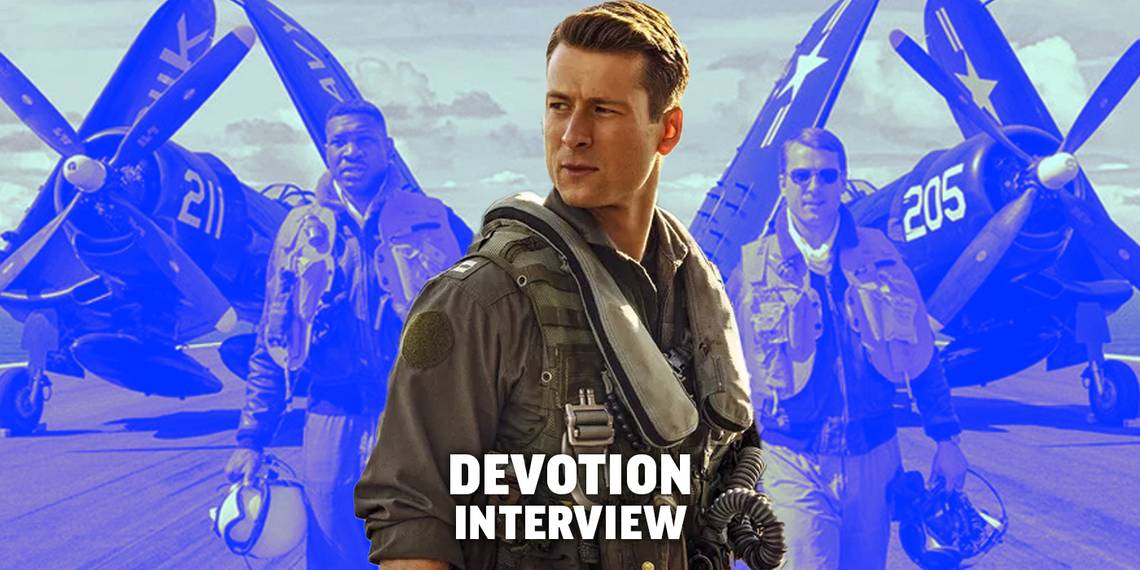
Glen Powell On What Makes A Leading Man


Photoshoots > Outtakes > Session 050
GQ – When Glen Powell showed up in Hollywood, the industry wasn’t quite ready for an actor of his qualities. In 2025, his unique blend of skillful physicality, raw charisma, and cocky swagger are made for the moment.
When Glen Powell was in his 20s, he wrote Sylvester Stallone a letter. At the time, Powell was still trying to succeed in Hollywood and, as he recently described it to me, at “the point of famine.” Stallone was casting the third installment of his aging-action-hero franchise, The Expendables 3. Powell, an unknown desperate to join the ranks of a call sheet full of over-the-hill action stars, recounted for Stallone the way he was raised. In Texas, Powell said in his letter, he grew up with a gun range in his basement, had learned to fight from his uncles, and had spent long stretches of his childhood trying to find new ways to cheat death.Improbably, the letter worked; Powell got the part. Even more improbably, nearly everything Powell wrote was true. “I mean, I wouldn’t say I was trying to cheat death constantly,” Powell said. But he did grow up “with a gun in my hand”; there was a range at the family’s ranch. Powell and his cousins would put on plays at the theater there—“The first play they had, they decided to do James Bond,” Powell’s mother, Cyndy, told me. “But there had to be seven James Bonds.” Powell would spend each summer learning how to do something new. “Whether it’s changing a tire or operating a tractor or breaking a horse,” Powell said. “They were big on skills in my family.”
Powell has since turned this kind of old-fashioned masculine competency into a career as a leading man. This fall, he is the star of both Chad Powers, a comedy series on Hulu, in which he plays a disgraced quarterback, and The Running Man, a big-studio action film from director Edgar Wright based on the 1982 novel from Stephen King. Where these two otherwise very different projects meet is where Powell excels: Both require a comfort in the character’s body, a natural athleticism that is often faked in Hollywood but is noticeable when real.
Powell has a strong jaw, brown hair that leans blond, and mischievous eyes. Onscreen and off, he projects both an eagerness and a certain alpha energy: Powell seems like a guy who would help you if your car broke down, but also like the type of guy who might strike you out on three pitches. Josh Brolin, who costars in The Running Man with Powell, told me that he asks a single question of people he works with: “Are you a bro, or not?” Meaning: “Are you the real deal? Are you a true friend? Or did you drink the Kool-Aid and are you full of shit?” Powell, Brolin said, is a bro. In his desire to win over audiences at any cost, he is reminiscent not so much of the other brooding, intensely interior stars of this moment—Timothée Chalamet, say, or Austin Butler—as a guy like Powell’s Top Gun: Maverick costar, Tom Cruise, who has become a mentor and friend. Total enthusiasm. Total commitment.
The movie business is a pendulum that swings. Or, as Powell puts it: “I think Hollywood, for the most part, is kids on a soccer field chasing a ball.” Until relatively recently, Powell was barely even on the field. It was the era of the moody vampire franchise Twilight, which premiered in 2008, and skinny, young leading men trapped helplessly inside their own feelings. “Robert Pattinson was probably the prototype,” Powell said, about the type of actor who was working at that time. Powell, a former Texas high school football player who still looks like a Texas high school football player, was so far from this prototype that even when Friday Night Lights came to his hometown of Austin, and began shooting, Powell couldn’t get hired. (Fellow Texas actor Jesse Plemons auditioned, too, around the same time; different result.) Casting directors generally called him, if they called him at all, for generic parts: “The jock or the fraternity guy or the very vanilla next-door-neighbor vibes,” Powell said. “You get cast into these very broad things.”
Then the business swung his way. “I remember when Chris Pratt broke out in Guardians of the Galaxy,” Powell said. “There’s no doubt it really helped—not being brooding or dark. Like, I’m not Christian Bale. Christian Bale has a gravitas and a weight, and Pattinson had his thing. And when Pratt kind of appeared on the scene where he was doing things that were a little more silly and buoyant, that’s where I feel most at home. And that’s where I feel like I had a gear that is a necessary flavor in terms of Hollywood, and not a gear that a lot of guys can play.” Edgar Wright told me he thought of Powell as a classic everyman: “He’s a conduit for the audience because he’s someone you can identify with or relate to.”
As things in Hollywood got a little sillier and a little more buoyant, Powell started working more: in Richard Linklater’s Everybody Wants Some!! (2016), as a college baseball player whose dreams and interests extend far beyond the field, and then in Hidden Figures, as the American astronaut John Glenn. In 2018’s Set It Up, a Netflix rom-com, Powell was cast as harried assistant to a venture capitalist—a version of a rote part he’d played before (see: “Trader #1” in 2012’s The Dark Knight Rises), but this time with prickly depth and charm. He also, crucially, was aging a bit. “The guys that I admired, they usually didn’t break until they were later in the game,” Powell told me. Michael Waldron, who created Chad Powers with Powell, said that he thought this, too, had something to do with Powell’s eventual success: “Maybe people were sick of just feeling like their heroes were boys. Glen feels like a man.”
In the roles that ultimately delivered Powell to real stardom, he played dicks. Men overconfident in themselves, on their front foot. The first of these, Hangman—the arrogant antagonist in 2022’s Top Gun: Maverick—was a role that Powell initially turned down. He’d been up for a bigger part in the film, one that ultimately went to Miles Teller. So he walked. Until, that is, Cruise convinced him otherwise. “He was passing on the film without really looking at it and evaluating it from every angle—without gathering all the information on the process of how I approach making movies, my career, all the talented artists that were involved, and how the film is actually going to be made,” Cruise told me.
Hangman became the first of a signature type for Powell, one that he’d quickly reprise: first as Gary Johnson, a mild-mannered birdwatcher who comes to life when he goes undercover as Ron, a suave contract killer, in 2023’s Hit Man, and then as Tyler Owens, a self-described tornado wrangler in 2024’s Twisters. “Anybody that you’ll meet that knows me from elementary school, middle school, like high school, I was not Mr. Cool,” Powell said. “I’ve never been Mr. Cool. And what’s funny is you start getting cast in certain things—like Hangman is not me, right? I’m not that guy.” Richard Linklater told me: “When you grow up in Texas, there is this kind of swagger-y character that Glen isn’t, but Glen knows.”
But one thing Powell learned, in his years trying to make it, is that who you see yourself as and who the movie business might want you to be are often not the same thing. “That’s the funny part about Hollywood,” Powell said. “You can’t really choose it. People have to cast you in these movies. And I think what I started realizing is that people got enjoyment out of watching me be really cocky and confident.”
Powell can play cocky, but what he really enjoys is what comes afterward. He told me a story about his uncle Billy—one of the uncles who taught him how to fight. “There’s a story where someone tried to beat up his younger brother. This is in front of the family. This guy was rough with his younger brother, and Billy said, ‘Stop messing with him.’ And the guy hit him, and my uncle Billy grabbed this guy and just beat him to a pulp. And the whole time, while he was doing it, he said, ‘Why did you make me do this?’ And then he cried afterwards. So for the guy that’s on the ground, it must be the most confusing beatdown of his life. Why did you make me do this? And then the man cries.”
Powell likes these kinds of moments, when the whole thing gets upended and the confident guy has his confidence punctured. The moment where the jerk becomes a little less of a jerk. “I’m fascinated by the malleability of humans, our ability to change, our ability to become better,” Powell said. He is fascinated by the vulnerability in invulnerability.
Lately, Powell has been spending a lot of time in Scotland. The Running Man shot here, in part, as the production bounced between Glasgow, London, and Bulgaria. When that film wrapped, Powell had about two weeks off. In that time, he said, he went back to Dallas and “got my little sister married.” (You mean you attended her wedding? I asked. “Oh no—we got that girl hitched,” he said.) Then he came back to the UK to start production on a still untitled film from J.J. Abrams.
This summer, when I visited Powell in Glasgow, much of the city’s downtown had been shut down for filming; whole blocks were set-dressed as a futuristic, decaying metropolis. New Yorkers might have been annoyed, but Glaswegians seemed to have adopted Powell as a welcome guest, a kind of temporary city mascot. In the car from the airport to my hotel, the first thing I heard was a local radio DJ beseeching her audience: “Let me know if you see Glen Powell, will you? Just asking for a friend.”
Powell, now 36, is late enough to this kind of fame that he is mostly able to enjoy it. He takes amiable photos with poleaxed bachelorette parties and takes pride in the fact that nearly every citizen of Glasgow, including the veterinarian he once had to visit in the middle of the night, seems to know the name of his dog. (It’s Brisket.) He told me a story about walking home late after shooting, looking down at his phone, and looking up to see “probably 15 or 20 guys that seemed pretty tough. It was kind of a sketchy moment. And they looked up at me, and I was like, ‘Okay, I’m either about to be mugged or recognized.’ I can’t tell if they’re going to be like, ‘Hey, do you mind if we go get a selfie at 2:30 a.m.?’ Or is this a moment where I’m about to just get rocked?” (He survived.)
One afternoon, Powell took me on a tour of Glasgow, which was basically a tour of Running Man locations. In the film, Powell plays a man caught in a game show in which he is pursued by a legion of people trying to kill him. Powell showed me a street over by the university that they’d shot on, and then an alley behind some student housing where his character escapes from one side to the other. “You’re not going to have your mind blown,” he said, apologetically. We ended up at the Grosvenor Picture Theatre, one of the oldest movie theaters in Glasgow. A bemused employee let us wander around inside.
Powell, unsurprisingly, loves movie theaters. “Have you ever been to Jerry Bruckheimer’s house?” Powell asked me. (No.) Powell said he’d gotten to know Bruckheimer, the legendary producer responsible for everything from Pirates of the Caribbean to F1, while working on Top Gun: Maverick. “His theater is one of those things that you walk into his house and you go down—I mean, I need to make a lot more movies to afford Jerry Bruckheimer’s theater,” Powell said. “And on the wall, it’s all of these headshots of all the guys that he’s worked with, actors and actresses and famous folks and they have their signature on a little letter to Jerry and then you go down there and on the wall there’ll be, like, the helmet from Armageddon and the Bad Boys whatever, the little green balls from The Rock.”
Powell and I entered an empty theater. “I’m not sure, but I think that Linklater and I may have come here to promote Everybody Wants Some!!,” Powell said, looking around.
Everybody Wants Some!! was one of the first movies to showcase what Powell might be capable of, should anyone give him a chance. Linklater, whose specialty is spotting a peculiar kind of not-yet-known Texas talent (see: Matthew McConaughey in Dazed and Confused) had written a part that was difficult to cast. “I needed someone with some charisma who was going to be smart, who was also believable as a college athlete,” he said. Powell, Linklater told me, presented at the time “like this Beat character—he was even reading The Subterraneans, I think.” In other words: Powell was perfect.
“I loved his sense of the way he sang through life,” Powell said, of the character he played in the film—“the poetry he found in everything, the life lessons. The way that he rallied a group to find this epicurean existence. I literally was like, Oh my God, I wish I could be more like Finnegan on a day-to-day basis.”
Powell is, in fact, a lot like Finnegan, as far as I can tell. He is relentlessly cheerful and positive; his hunger for experience is total. “If somebody goes, Hey, you want to come meet me at this place? I’m like, yeah, sure. And I’ll literally just go and join. If somebody’s like, Hey, you want to come on this trip? I’m like, Hell yeah, let’s do it.” At dinner one night, after telling me about how he needed to be fresh for work in the morning, he watched me order a beer and crumbled immediately and ordered one too: “You know what? Fuck it.” When Powell and Linklater were working on Hit Man, which they wrote together, Linklater told me, “I was always in the same location: my library. Glen was always somewhere else. He was always on a beach somewhere, he was at some F1 race, he always had a best friend doing something. That guy is moving forward through this world.”
Powell’s enthusiasm for new experiences even seems to extend to the decade of rejection he faced before he broke through. He has told the story before: After acting in 2007’s The Great Debaters, which was directed by Denzel Washington, Powell was introduced by Washington to his agent, a legendary Hollywood character named Ed Limato. Limato—who helped discover Richard Gere and Michelle Pfeiffer—encouraged Powell to move to Los Angeles. Powell did. About two years later, in 2010, Limato died. Powell suddenly found himself in a strange town, more or less on his own.
Hollywood is a cruel place to young actors, a fact that is not fashionable to talk about should you be lucky enough to make it to the other side. But Powell will talk about it. “You’re human and you’re sensitive, and life comes at you hard,” he said. “I think it’s really important, when you get hit in the face and you’re bleeding and your nose may be broken, you’ve got to take stock and say, ‘Okay, let’s reassess. How do I get my hands up next time?’ ” Like the characters he plays, Powell is drawn to combat, but he is more drawn to what happens after the punches land. “That’s where I feel like vulnerability is the greatest sense of masculinity,” he said. “Not acting like nothing hurts and not trying to act like that journey is painless.”
Powell is unselfconscious about having failed before succeeding. “I just find that it’s cool and tough to be open and vulnerable, and maybe that’s just where it comes from with my family, but my family’s all on the table and no one ever judges you for it.” Agents, in the past, have told Powell to play it cool—“I, like, bought a leather jacket at one point, and the deep V,” Powell said, laughing, “but it just didn’t work out. It was short-lived”—and to not be so honest about how hard he’s trying all the time. But Powell takes great pride in trying. “If you’re in Hollywood, I always find it to be very disingenuous when people are driving across town to the Valley in the heat of summer, memorizing two lines, practicing them a thousand times and then acting like they don’t care,” Powell said. “The amount of work that it takes, I always find that people that downplay it, which—it’s fine to downplay it, but I’ve never been a guy that can play it cool. I’ll tell you exactly how I’m feeling with all of it. I don’t know any other way to do it.”
Edgar Wright told me that when he was casting The Running Man, Powell reached out to him directly. “Actors don’t often do this, because there is a process of just going through agents, and some people fear rejection if they reach out and it doesn’t work out,” Wright said. “But Glen sent me a text, and he said, ‘Hey I don’t know if this is true or not, but I heard my name might be in the mix for The Running Man.’ And he basically said, ‘If there were ever the opportunity to work with you, I promise you I’d work harder than any other actor you’ve worked with.’ And you know what? He was right.”
Now that Powell has found a measure of success, he is equally honest about his excitement about that. “This is cool,” he told me. (Glen Powell loves the word cool.) “I have wanted to do this since I was a kid, and it’s awesome.” Earlier this year, Powell said, he was in London, visiting the set of a movie that Tom Cruise was making with the director Alejandro González Iñárritu. It was the day the director David Lynch passed away, and Powell watched as Cruise and Iñárritu gathered everyone for a moment of silence. “And they talked about his career. It was right before the shooting day started. And they said, ‘Can we talk about what an amazing guy this guy was, and what he created for filmmaking? We’re about to get the honor of making a movie, let’s talk about the guy.’ I was like, What a cool thing.”
Powell said that Josh Brolin, his costar in The Running Man, would often do something similar, taking a moment to remind those around him that they are lucky to do what they do. “I think it’s really cool when people I like and respect are really hitting the Pause button, and being like: This is amazing. I just want you to take that in. When a movie star does that—when somebody of that level presses Pause and says: Hey, this is awesome. Just remember: This is awesome.”
Brolin told a story about Powell getting ready for a scene they were doing together. “Glen is sitting there over and over, slamming his fist down on his thigh, and I’m like, ‘Goddamn, let up on yourself, dude.’ But: into it! Works himself into a state. And that can be embarrassing.” At a glance, something like The Running Man, Brolin said, could seem superficial—nothing to get worked up over. “You’re like, ‘Hey, man, it’s The Running Man, relax.’ You know? ‘It’s Big Top Pee-wee, it’s okay.’ And it’s not that. And he refuses to do that. And I don’t care if you’re cold plunging every morning, I don’t care what it is. I just want to see you doing it. I just want to see you proving to yourself that you’re there for real.”
One morning in Glasgow, Powell and his driver picked me up from my hotel. On our way to breakfast, we passed more locations for the J.J. Abrams film Powell was currently shooting. Powell said he had recently been negotiating with his home state to make it more possible for productions to shoot there. “There’s a few things in the deal points that I’m trying to get amended a bit, but Texas just passed a massive film incentive,” he said.
I asked Powell if he had elected himself to this role as Hollywood ambassador to the state, or whether he’d been asked to help. “I went to the Capitol when, probably when I was 17, 16, to talk about the incentives.” But, he said, “It is only now that I feel like I’m sort of one of the maybe four or five people that represent Texas in Hollywood that they’ve sort of been like, ‘Hey, we need you. It’s you. McConaughey, Woody, Owen.’ There’s not that many of ’em.”
The car pulled up to a restaurant on the east side of Glasgow’s downtown. When we walked in, the restaurant staff audibly giggled at the sight of Powell. We sat down and looked at the menu. “Would you mind, would it be annoying if I did sort of a customized version?” Powell asked the waiter.
One of the many ways that Powell symbolizes the peculiar dilemmas of modern manhood is the intense and deliberate way he takes care of himself and his body. He is a bona fide bro from Austin—increasingly, America’s home of a familiar strain of male optimization—who cold plunges, infrared saunas, and, on a nearly daily basis, submerges his face into a bowl of ice cubes.
In The Running Man, Powell does many of his own stunts. “I knew that based on the Stephen King book, Ben Richards was a tank,” Powell said about his character in the film. So Powell, with the guidance of Cruise, who taught him how to outline and prepare for the major stunts in a film, worked to become a tank. “I was like, Okay, I got to be a bit of a weapon. And so that’s why I trained the way I trained on this. I put on a lot of muscle. A lot of it was functional. A lot of it was so I could absorb hits. But a lot of it was also authentically for an audience.” It was Cruise who taught Powell to think about the job of acting as an inherently physical one. “I went from going, ‘Oh, I’m an actor on a movie,’ to ‘I’m a high-performance athlete,’ ” Powell told me. “And I’m just very lucky that I have someone like Tom who I could literally go, ‘Hey, what do I do to survive something?’ ”
Like Cruise, Powell is committed to making himself into the kind of leading man who might withstand decades at the front of giant action films. We had been talking about evolving definitions of manhood in Hollywood—“When you look at actors of yesteryear, if they’re hitting at 36, they look like Gene Hackman in The Royal Tenenbaums,” Powell said—and what it now takes. “Speaking of masculinity,” Powell said, “I feel like that is one of those things, the health and wellness thing, that used to not feel like guys’ owning that space as much. And I do feel like the tide is gonna turn on that, where it’s a space that I’ve been really interested in for a while, but I feel like it’s also now becoming a little bit more in vogue. When I go back to LA, when I socialize and bring guys together, instead of just going, ‘Hey, let’s all go grab a drink,’ a lot of times I’ll just bring ’em all to a sauna and I’ll just load all my buddies in a sauna. And everybody appreciates it. Go sauna and cold plunge together.”
Powell told me a story about being on the set of Top Gun: Maverick with Cruise. “Cruise gave me shit,” he said. “Somebody was like, ‘Hey, do super coffee.’ ” Super coffee, Powell explained, is like coffee, but with mushrooms and a bunch of other alleged superfoods. “So you put ashwagandha and reishi and Cordyceps and all these things in your coffee. So I blended it, mixed it up, put it in this kind of a mason jar and brought it to set. I’m flying that day so I’m drinking this thing. But it’s all these ground-up mushrooms—it kind of looks like just this hearty, just disgusting…. He kind of looks at me for a second, he’s like: ‘You look like you’re drinking a stool sample. What is that?’ I was like, ‘Okay, this one, I took this too far.’ ”
Powell’s faith in the prospect of decades of stunts in front of cameras is also a statement of faith in his industry, and movies that play in actual movie theaters, at a moment when many have begun to doubt it. “When people say theatrical is dead or it’s dying, whatever, I just so disagree,” Powell said. “One of the things I’m really trying to do right now just as a actor, as a producer, as a writer, is—when you prove that something can work theatrically, it gives confidence to everyone afterwards to be making those types of movies.”
This was one of the lessons Powell took away from the startling success of 2023’s Anyone But You. “Some of my favorite experiences in the theater are with rom-coms,” Powell said. “It’s a feel-good thing. It always makes you leave better than when you entered, if you do it right. And it was like a genre that had sort of gotten relegated to Netflix only.” (For instance: Set It Up, a rom-com in the world of personal assistants that was a hit on Netflix but did not really shift the trajectory of Powell’s career.) Powell said he’d once had a conversation with Jerry Bruckheimer about the Pirates of the Caribbean franchise—“Bruckheimer was literally like, ‘They said pirate movies are dead.’ And Bruckheimer was like, ‘When anybody says something is dead, it means everyone’s forgetting about it, and there’s an opportunity there.’ ”
Powell had had movies succeed before, but Anyone But You—a frothy, TikTok update of Much Ado About Nothing set vividly in Sydney, Australia—was his first true experience with a particular kind of viral stardom. “When anything is new and out loud—if you walk into a rave out of bed, there’s some adjustment,” he said, reflecting on the experience. “All of a sudden you’re like, ‘What am I doing here? What’s going on?’ But it’s just an adjustment. There’s an acclimation process and soon enough you’re dancing, you’re figuring it out.”
Part of the viral attention Powell and his costar Sydney Sweeney received for Anyone But You stemmed from what audiences perceived to be a romance between the two actors, who were in other relationships while filming the movie. After Anyone But You became a success, Powell and Sweeney even did a victory tour, taking credit for the rumors of an affair and the interest it fueled in the movie.
Recently, though, Powell’s former partner from those years, Gigi Paris, had made news by alleging that Powell and the producers of Anyone But You had gone so far as to ask Paris not to come to the set of the film, kicking off another wave of tabloid hysteria. In Glasgow, Powell said he was obviously committed to selling the movie but didn’t exactly agree with her account. “I will always have nothing but love for her and respect for her,” he said, carefully. “Everybody’s always going to have their own narrative on things and all that. And she’s welcome to it.” He gestured at the two of us, sitting together at breakfast. “Relationships are really hard. And when two people break up, they each go to their own brunch and they will each tell their own narrative.”
Another piece of Cruise advice he relies on these days: “He basically said, ‘Hey, it’s going to get really, really loud. It’s your job to just turn the volume down. Just remember you have your hand on that switch. You have your hand on the ability to turn up that noise or turn it down.’ And really just turning down the noise and trusting your own gut has been a real godsend for me.”
Powell’s father, Glen Sr., who is an executive coach, told me the Powell family has a motto: “Advance on all fronts.” In Powell’s famine years in Hollywood, this meant not just auditioning but screenwriting—an uncharacteristic pursuit for an actor with aspirations toward being a leading man. Powell sold some scripts. But it wasn’t until the pandemic hit, and Top Gun: Maverick—the film that was going to make Powell famous, if only anyone could see it—was delayed from 2020 until 2022, that Powell wrote something that actually got produced.
Hit Man, cowritten with and directed by Linklater, is a playful film from 2023 about a guy in denim shorts named Gary Johnson who goes undercover on behalf of the New Orleans Police Department as a variety of contract killers. Powell plays the fake hit men with typical enthusiasm, in a cavalcade of wigs, accents, and facial hair. Johnson, who lives a quiet life, is visibly thrilled to be trying on a series of more dramatic ones. Powell, watching the film back for the first time in the editing room with Linklater, quickly realized how personal the movie actually was. “I was like, oh—this is a very weird exploration of my head and my heart.”
We were at dinner, in a restaurant over by the university in Glasgow.
“In what way?” I asked Powell.
“I mean, I think you can see it’s not just masculinity, but it’s identity and it’s like how we move through the world, how we best move through the world, what makes us the best version of ourselves—who makes us the best version?”
In the fall of 2023, Powell and Linklater ended up selling Hit Man to Netflix for a reported $20 million; Anyone But You came out that December and ultimately grossed $220 million in theaters. In the summer of 2024, Powell starred in the big-budget reboot Twisters—another hit.
Now able to do whatever he wanted, Powell chose to…write, produce, and star in a television show, based on a character created by the two-time Super Bowl–-winning quarterback Eli Manning for his ESPN+ show, Eli’s Places. The plot of the show, Chad Powers, is proudly absurd: After a college quarterback named Russ Holliday humiliates himself on the sport’s biggest stage, and spends the next eight years spiraling, Holliday reinvents himself—with the help of a suitcase full of prosthetics, a soft goofy accent, and the name Chad Powers—as a walk-on QB at the University of South Georgia. Michael Waldron, Powell’s cocreator, summed up what he imagined many people’s first reaction to this premise would be: “ ‘I think that this is probably going to be a piece of shit.’ ” But, Waldron told me, “to me that was kind of one of the advantages of the show. How on earth could they make something compelling out of this?”
Chad Powers is funnier, more heartfelt, and much weirder than it needs to be, dense with allusions to the shows and movies Powell and Waldron are paying reference to; in the first episode, the show name-checks Euphoria, The Whale, and the otherwise forgotten 2003 sports drama Radio. “We hang lanterns on exactly what we’re doing,” Powell said. “We’re like, we want this episode to feel like Good Time. We want this to feel like a Safdie brothers movie. We want this one to feel like an old sports movie like Rudy or The Natural or something like that. It’s like, okay, this one should feel like a little bit more like romance. It should feel like a Nancy Meyers beat.” Powell and Waldron both brought up the Robin Williams vehicle Mrs. Doubtfire, where a divorced guy pretends to be a nanny in an effort to see his kids; Armageddon, with its oil drillers in space, was another shared touchpoint. “Armageddon is the craziest idea possible,” Powell said. “It makes no sense, but it is a movie that from start to finish, you are on that ride and you are enjoying it.”
Russ Holliday is another addition to the rogues’ gallery that Powell has been building these past few years: desperate, conceited, unkind. “In part because Glen is such a good guy, I think that’s why he’s so good at playing an asshole,” Waldron said. “Because you can write, as we did in Chad, fairly unlikable actions or things for him, and the audience is going to hang on because there’s a magic to him. Whatever makes him a movie star makes the audience believe that he’s going to figure it out, and they want to go with him on that journey.”
Powell said he was drawn to the character of Russ Holliday not for who he starts out as but for who he becomes. “If you look at Chad Powers, it is a contemplation on masculinity, right? It’s a guy who we were putting in the most masculine arena there is. And having a guy make a mistake. What a normal, well-adjusted man would do, who is actually confident and not insecure, would just be to say, ‘I’m sorry.’ He would say, ‘I made a mistake,’ and move on. He doesn’t have that ability. So he keeps doubling down. He takes zero accountability, doubles down on these bad habits, and goes to the furthest lengths to not say, ‘I’m sorry.’ ”
By pretending to be Chad, Holliday is redeemed. “It’s not dissimilar from the treatment that we did with Hit Man, which is, by putting on the mask of someone else you can’t help but have those sort of things seep in and become you,” Powell told me. “And that was something that I’ve been marinating on, that I’ve been thinking about. And it’s really fun how it kind of comes out in different characters. So I think people will see the things that I am writing and putting together, like Chad Powers—it’s a lot of stuff that I think about and I wrestle with and you don’t realize, I think, until all of a sudden you’re in the editing room where: Wow, this is a really personal story.”
Powell keeps returning to the same idea: How do we get back to our best selves? How do we self-optimize? Could it be by being, however briefly, someone else?
Until very recently, Powell was getting cast in movies the same way he was a decade ago: by auditioning for them. “I auditioned for Twisters,” he said. “I was a gun for hire. I wasn’t building that movie myself. ”
This is no longer the case. Even on something like the J.J. Abrams film—“I’m not producing, but J.J. and I have been working on this for a while, so I’ve had a stronger hand,” Powell said. He envisions a future where he always has a role, creatively, in shaping the parts he plays, whether as a writer, producer, or collaborator. Powell and Ron Howard just announced a project together. He said he was working with Barry Jenkins on something. “Being at the ground floor with these guys, it just changes,” Powell said. “I just engage with it differently—it’s not off-the-rack. It’s couture.”
Part of what he is after, Powell said, is the experience he’d had with Hit Man and Chad Powers, where in creating a character he’d learned something about himself, had perfected and otherwise evolved the ongoing project of Glen Powell. “They’re all a piece of you,” Powell told me. “Hit Man is about my experience as an actor. It’s this idea that every role that Gary Johnson played was a piece of Gary Johnson. It’s not a life that he lived, but he gets to step into all these different pieces, and even though he’s disappearing and transforming, there’s a spirit of him in everything.”
Powell is perhaps the ideal vessel for audience wish fulfillment these days because he feels the exact same way that audiences do about the guys he plays. “Like Tyler Owens in Twisters, it’s like, who doesn’t want to be the guy that drives a truck towards something that can kill him?” Powell said, grinning. “Understanding the science and the romance behind it, and also having a crew of buddies that you’re hauling ass across the Plains in a truck. There’s a sense of: That’s a modern cowboy. There was something about that that was like: Who doesn’t want to be that guy?”